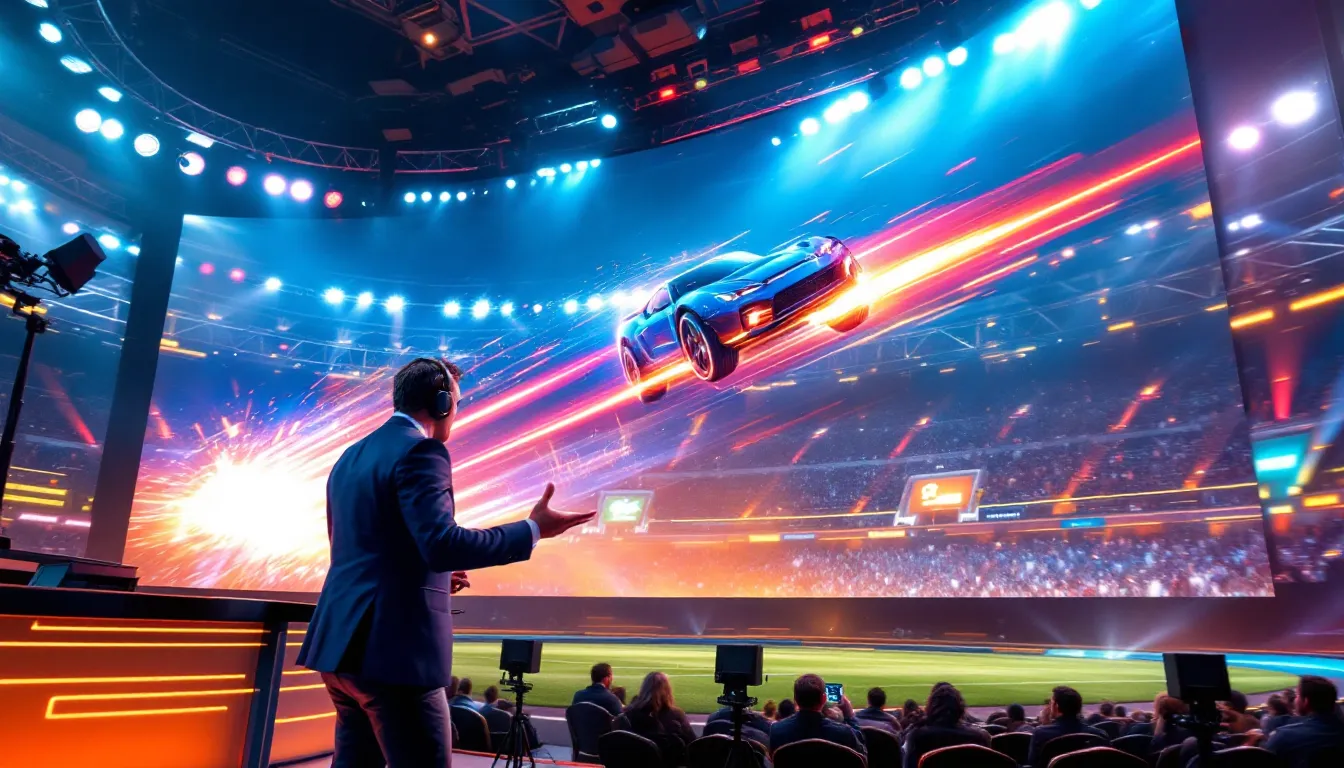
When Dota 2 commentator Daniel “ddk” Kapadia shouted “THIS IS ROCKET LEAGUE.” during the RLCS Season 3 Grand Finals in 2017, he unknowingly crystallized an entire game’s identity into three words. That moment, when 0Seconds pulled off an impossible overtime goal against Northern Gaming, captured everything that makes Rocket League unforgettable: chaos, precision, and pure adrenaline.
Nearly a decade later, Rocket League remains one of the most competitive and accessible esports titles in existence. The free-to-play model introduced in 2020 brought millions of new players into the arena, and the 2026 competitive season is shaping up to be the most intense yet. Whether you’re grinding ranked 2v2s, perfecting ceiling shots in training, or just trying to understand why everyone keeps spamming “What a save.” after you whiff, this guide breaks down everything you need to know about Rocket League in 2026.
Key Takeaways
- The phrase ‘THIS IS ROCKET LEAGUE’ originated in 2017 when commentator ddk captured the game’s chaotic brilliance during an impossible overtime goal, becoming an iconic rallying cry for unpredictable moments that define competitive play.
- Rocket League remains one of the most competitive esports in 2026 due to its infinite skill ceiling, free-to-play accessibility, and continuous discovery of new mechanics and techniques even after thousands of hours.
- Boost management, rotation positioning, and aerial control are the three core skills separating casual players from competitive ones in Rocket League.
- The 2026 RLCS season features three regional splits with a $2.5 million world championship prize pool, strong six-figure viewership, and increased competitive parity outside the traditional top teams.
- Mastering Rocket League fundamentals—ball control, defensive rotation, and consistent mechanical execution—matters more than flashy tricks when climbing the competitive ranking ladder.
- The game’s longevity stems from its simple premise (hit ball into goal) combined with an impossible-to-master skill ceiling that rewards deliberate practice, replay analysis, and patience with the learning curve.
What Does ‘This Is Rocket League’ Actually Mean?
The Origin of the Iconic Phrase
The phrase originated during the RLCS Season 3 World Championship on June 4, 2017. In a jaw-dropping overtime moment, 0seconds’ player scored an aerial redirect that seemed physically impossible under pressure. Commentator ddk’s spontaneous reaction, “THIS IS ROCKET LEAGUE.”, became an instant meme and rallying cry.
What made the moment transcendent wasn’t just the goal itself, but what it represented. Rocket League regularly produces plays that defy expectation, where physics and player creativity collide in ways that feel impossible even after you’ve watched the replay five times. The phrase captures those moments when the game stops being about cars hitting a ball and becomes something genuinely spectacular.
Why It Became a Cultural Phenomenon
The phrase resonated because it perfectly encapsulates Rocket League’s identity: unpredictable, explosive, and inherently dramatic. Unlike traditional sports games that simulate real-world activities, Rocket League creates entirely new possibilities. A Bronze player can accidentally score a ceiling shuffle, and a Grand Champion can completely potato an open net.
This accessibility combined with a skill ceiling that seems infinite creates constant “THIS IS ROCKET LEAGUE” moments. The phrase has appeared on merchandise, tournament broadcasts, and player montages for nearly a decade. It’s become shorthand for anything that captures the game’s chaotic brilliance, whether that’s a zero-second team pinch from midfield or three players simultaneously missing the same stationary ball. According to coverage from major esports media outlets, the phrase remains one of the most recognizable callouts in competitive gaming history.
Understanding Rocket League’s Core Gameplay Mechanics
The Basics: Soccer Meets High-Octane Racing
At its core, Rocket League is simple: two teams, one ball, five minutes. Hit the ball into the opponent’s goal more times than they hit it into yours. But the execution is where things get interesting.
Each player controls a rocket-powered car with the ability to jump, dodge, and fly. Cars can drive on walls and ceilings. The ball’s physics respond to speed, angle, and spin with surprising realism. There’s no RNG, every touch is deterministic, meaning the same hit will always produce the same result.
The standard mode is 3v3, though 2v2 and 1v1 are equally competitive. Matches run for five minutes, with unlimited overtime if the score is tied. Platform availability includes PC (Steam and Epic Games Store), PlayStation 4/5, Xbox One/Series X
|
S, and Nintendo Switch, with full cross-platform play enabled.
Boost Management and Positioning
Boost is the game’s most critical resource. Small boost pads scattered across the field provide 12 boost each, while corner boost pads grant 100. You can carry a maximum of 100 boost at any time.
Good players collect boost constantly without sacrificing positioning. Bad players drive to corner boost while their teammates get scored on. The difference between ranks often comes down to boost efficiency, knowing when to grab pads versus when to use your remaining boost to challenge or rotate back.
Positioning follows a rotation system. In 3v3, one player challenges the ball, one supports from midfield, and one hangs back as last defender. As the play develops, players rotate through these positions continuously. Breaking rotation is the fastest way to give up goals and tilt your teammates.
Aerial Plays and Advanced Techniques
Aerial ability separates casual players from competitive ones. The basic aerial involves jumping, tilting your car back, and boosting toward the ball in mid-air. Sounds simple. It’s not.
Advanced aerial mechanics include:
- Fast aerials: Jump and boost simultaneously, then immediately dodge backward while holding boost. Generates maximum liftoff speed.
- Air roll: Rotating your car mid-flight for better ball contact angles and recovery.
- Ceiling shots: Dropping from the ceiling to maintain your flip and create unpredictable angles.
- Flip resets: Touching all four wheels to the ball mid-air to regain your dodge.
Most players don’t need flip resets to rank up, but fast aerials and basic air roll become essential around Diamond rank. The mechanical skill ceiling extends infinitely upward, professional players continue discovering new techniques even after thousands of hours.
The Competitive Rocket League Scene in 2026
Major Tournaments and Championship Series
The Rocket League Championship Series (RLCS) remains the premier competitive circuit. The 2026 season follows a regional format with three splits: Fall, Winter, and Spring. Each split culminates in a Major tournament, with the season ending in the World Championship.
Prize pools have continued climbing, with the 2026 World Championship offering $2.5 million total. Regional events cover North America, Europe, South America, Oceania, Middle East & North Africa, Asia-Pacific North, and Asia-Pacific South.
Beyond RLCS, major tournaments include:
- Gamers8 (Saudi Arabia’s multi-million dollar esports festival)
- DreamHack circuit events
- Community-run tournaments like The Salt Mine and Fusion
The competitive scene’s health in 2026 is strong, with viewership consistently hitting six figures during Major broadcasts. Psyonix’s continued investment in esports infrastructure has kept Rocket League relevant even as newer titles compete for attention.
Top Professional Players and Teams to Watch
The professional landscape shifts constantly, but several names dominate the 2026 season.
Top Teams (as of March 2026):
- Team Vitality (EU): Consistently top-tier with explosive offensive play
- G2 Esports (NA): Mechanical powerhouses with championship pedigree
- FURIA Esports (SAM): South America’s finest, known for creative rotations
- PWR (OCE): Oceania’s representatives bringing physicality and speed
Players to watch:
- Vatira (Vitality): Arguably the most mechanically gifted player currently competing
- Daniel (G2): NA’s young prodigy with frightening consistency
- Yanxnz (FURIA): South American talent breaking through on the world stage
- Joyo (EU free agent): Former world champion with championship experience
The scene’s depth has increased dramatically. Teams outside the traditional top 8 regularly upset favorites, and regional parity continues improving. Professional coverage from outlets analyzing competitive rankings and rosters helps fans track roster changes and team performance throughout the season.
Essential Skills Every Rocket League Player Must Master
Ball Control and Dribbling Fundamentals
Ball control means keeping the ball close to your car while maintaining speed and direction. It’s harder than it sounds. The ball bounces differently depending on your car’s hitbox, and maintaining control while an opponent challenges requires reading both the ball and your opponent simultaneously.
Dribbling progression:
- Ground dribbling: Keep the ball on top of your car while driving. Requires feathering boost and making micro-adjustments.
- Flicks: Pop the ball off your car by front-flipping or side-flipping at the right moment. Creates powerful, unpredictable shots.
- Air dribbles: Carry the ball through the air by matching its trajectory and repeatedly boosting into it.
Most players overcomplicate dribbling. Start by just keeping the ball close on the ground. Learn to change direction without losing possession. The fancy stuff comes later.
Defensive Rotation and Team Communication
Defense wins games, even if highlight reels suggest otherwise. Good defense in Rocket League is about positioning, not making spectacular saves.
Defensive fundamentals:
- Last man stays last: If you’re furthest back, don’t chase the ball. Cover the net and trust your teammates to challenge.
- Shadow defense: Match an opponent’s speed and angle without committing to a challenge. Forces them to make the mistake.
- Boost denial: Clear boost pads on defense to starve opponents of resources for their attack.
- Recovery speed: After every touch, land on your wheels and immediately orient toward the play.
Team communication varies by platform. PC players often use Discord or in-game voice chat. Console players rely more on quick chat. At higher ranks, communication becomes less verbal and more predictive, you should know where your teammates are without asking.
Speed Flips, Air Rolls, and Mechanical Mastery
Speed flip is the fastest way to move from standoff positions. It’s a diagonal flip with simultaneous air roll and directional input that cancels the flip animation while preserving momentum. Essential for kickoffs at Diamond+ ranks.
Execution:
- Jump and dodge diagonally forward
- Immediately pull your stick backward while air rolling
- Land on your wheels with boost ready
It takes hours of practice to execute consistently, but it’s the difference between winning and losing kickoffs against equally skilled opponents.
Directional air roll (binding air roll left or air roll right to a dedicated button) allows for more precise aerial control. Professional players use directional air roll for nearly everything, recoveries, aerial shots, and flip resets. It looks smooth because it is smooth, but it requires rewiring your muscle memory.
Mechanical mastery isn’t about learning every freestyle trick. It’s about executing fundamentals perfectly under pressure. A well-timed power slide cut is often more valuable than a double flip reset.
Ranking System and How to Climb the Competitive Ladder
Understanding MMR and Rank Distributions
Rocket League uses a Matchmaking Rating (MMR) system that assigns each player a hidden numerical value. Your visible rank is just a representation of this number.
2026 Rank Distribution (approximate):
- Supersonic Legend: Top 0.02% (2200+ MMR)
- Grand Champion III: 0.1%
- Grand Champion II: 0.3%
- Grand Champion I: 0.8%
- Champion III: 2.5%
- Champion II: 4%
- Champion I: 7%
- Diamond III: 10%
- Diamond II/I: 15%
- Platinum and below: Remaining 60%
You gain or lose MMR based on match results, with adjustments for opponent strength. Beating higher-ranked opponents yields more MMR. Losing to lower-ranked opponents costs more.
Each playlist (1v1, 2v2, 3v3, Extra Modes) has separate MMR. Many players rank higher in team modes than 1v1 because positioning can mask mechanical weaknesses. 1v1 is brutally honest, you can’t blame teammates for your mistakes.
Training Routines That Actually Work
Free play is the most efficient training tool. Pros spend hours in free play just hitting the ball around, practicing recoveries, and building car control. It’s boring. It works.
Effective training routine (30 minutes):
- Free play warmup (10 min): Hit the ball hard, recover quickly, maintain movement. Don’t think, just hit.
- Custom training packs (10 min): Find packs for your weak points. Missing aerials? Aerial redirect packs. Bad at backboard defense? Backboard save packs.
- Positioning drills (10 min): Shadow defense in free play against the ball, or play 1v1 casual matches focusing purely on positioning.
Workshop maps on Steam (like Rings maps or Dribbling Challenge 2) accelerate car control development. Console players can use custom training codes shared by the community.
The fastest way to rank up isn’t mechanical training, it’s watching your own replays. Record a loss, watch it from your perspective, and count how many times you:
- Challenged when you should’ve rotated back
- Went for boost instead of covering net
- Cut rotation and bumped a teammate
- Attempted a mechanic you can’t execute consistently
Fix those decisions, and you’ll climb faster than any amount of training pack grinding.
Game Modes, Customization, and Community Features
Popular Game Modes Beyond Standard 3v3
While competitive 3v3 is the flagship mode, Rocket League offers substantial variety.
Ranked playlists:
- 1v1 Duel: Pure mechanical skill and mental warfare. Extremely punishing but the best teacher.
- 2v2 Doubles: The most popular ranked playlist. Fast-paced with heavy emphasis on rotation.
- 3v3 Standard: Team-oriented, strategic, and the focus of professional play.
Extra Modes (all ranked):
- Hoops: Basketball variant with elevated goals
- Rumble: Power-ups like grappling hooks and spikes create chaotic gameplay
- Dropshot: Hexagonal floor that breaks when hit, requiring vertical ball control
- Snow Day: Hockey with a puck instead of a ball
Casual modes include the same playlists without rank pressure, plus Limited Time Modes that rotate every few weeks.
Tournaments run daily at scheduled times, offering free cosmetic rewards for winning. They’re 32-team single-elimination brackets that take about 30-45 minutes if you make a deep run.
Extra Modes have dedicated communities. Some players exclusively play Rumble and hit Grand Champion without ever touching standard modes. Different modes develop different skills, Hoops improves aerial accuracy, Snow Day teaches bounce prediction, Rumble forces adaptability.
Car Bodies, Decals, and the Trading Economy
Cosmetics have zero impact on gameplay (with the tiny exception of hitbox differences between car bodies). The game uses six standardized hitboxes: Octane, Dominus, Hybrid, Breakout, Plank, and Merc.
Octane dominates professional play, roughly 85% of pros use it. The hitbox is tall and forgiving for aerials and dribbling. Fennec (Octane hitbox) is equally popular because its visual model matches the hitbox more precisely.
Customization includes:
- Car bodies (different hitboxes and visuals)
- Decals (paint jobs)
- Wheels, boosts, toppers, antennas
- Goal explosions and engine sounds
- Player anthems and titles
The trading economy collapsed somewhat after Epic Games removed player-to-player trading for most items in late 2023, but a secondary market still exists for legacy items and codes. Titanium White variants of popular items (Octane, Fennec, Zomba wheels) remain status symbols.
The Item Shop rotates daily, offering bundles for real money. Rocket Pass is the seasonal battle pass offering 70+ tiers of unlockable cosmetics for 1000 Credits (about $10). It pays for itself if you complete it, making it the most cost-effective cosmetic investment.
For players who don’t care about cosmetics, the game provides everything needed to compete at the highest level for free. Detailed information about car statistics and customization options can be found through major gaming coverage sites that regularly update Rocket League content guides.
Why Rocket League Continues to Dominate in 2026
Nine years after that iconic “THIS IS ROCKET LEAGUE” moment, the game hasn’t just survived, it’s thrived. The free-to-play transition brought in a massive player surge, and cross-platform play ensures healthy matchmaking across all regions and platforms.
Several factors explain its longevity. The skill ceiling remains practically infinite, meaning even players with thousands of hours still discover new techniques and strategies. The gameplay loop is addictive: matches are short enough that “one more game” rarely stops at one, but deep enough that improvement feels tangible.
Psyonix’s commitment to competitive integrity helps too. Balance patches are conservative and thoughtful. The game hasn’t been dramatically overhauled or ruined by chasing trends. It’s still fundamentally the same game that launched in 2015, just refined and expanded.
The esports ecosystem provides aspirational content. Watching RLCS isn’t just entertainment, it’s a masterclass in high-level play. Players watch pros, learn techniques, practice them, and see immediate results in their own games. That feedback loop keeps the community engaged and constantly improving.
Community-created content extends the game’s life as well. Workshop maps, training packs, custom tournaments, and content creator involvement create an ecosystem that transcends the base game. When players get bored of ranked, there’s always something else to try.
Rocket League’s success comes down to a simple formula: easy to understand, impossible to master, endlessly rewarding. You can explain the rules to someone in fifteen seconds. You can spend fifteen hundred hours and still whiff open nets. And somehow, that combination keeps millions of players coming back every day, chasing that perfect shot, that clutch save, that “THIS IS ROCKET LEAGUE” moment that reminds them why they fell in love with the game in the first place.
Conclusion
Rocket League isn’t just a game about cars playing soccer. It’s about the moments when everything clicks, when your aerial reads are perfect, your rotations are clean, and the ball goes exactly where you intended. It’s about learning from embarrassing losses and grinding through plateaus until you finally break through to the next rank.
Whether you’re just starting out or pushing for Grand Champion, the path forward is the same: play more, practice deliberately, watch your replays, and stay patient with the learning curve. The game rewards consistency and smart play over flashy mechanics. Master the fundamentals, understand positioning, and the mechanical skill will come.
The phrase “THIS IS ROCKET LEAGUE” endures because it captures something genuine, the chaos, the skill, the impossible moments that happen when physics and player creativity collide. Every player, regardless of rank, has experienced that moment. And that’s why, nearly a decade after launch, Rocket League remains one of the most compelling competitive games ever made.