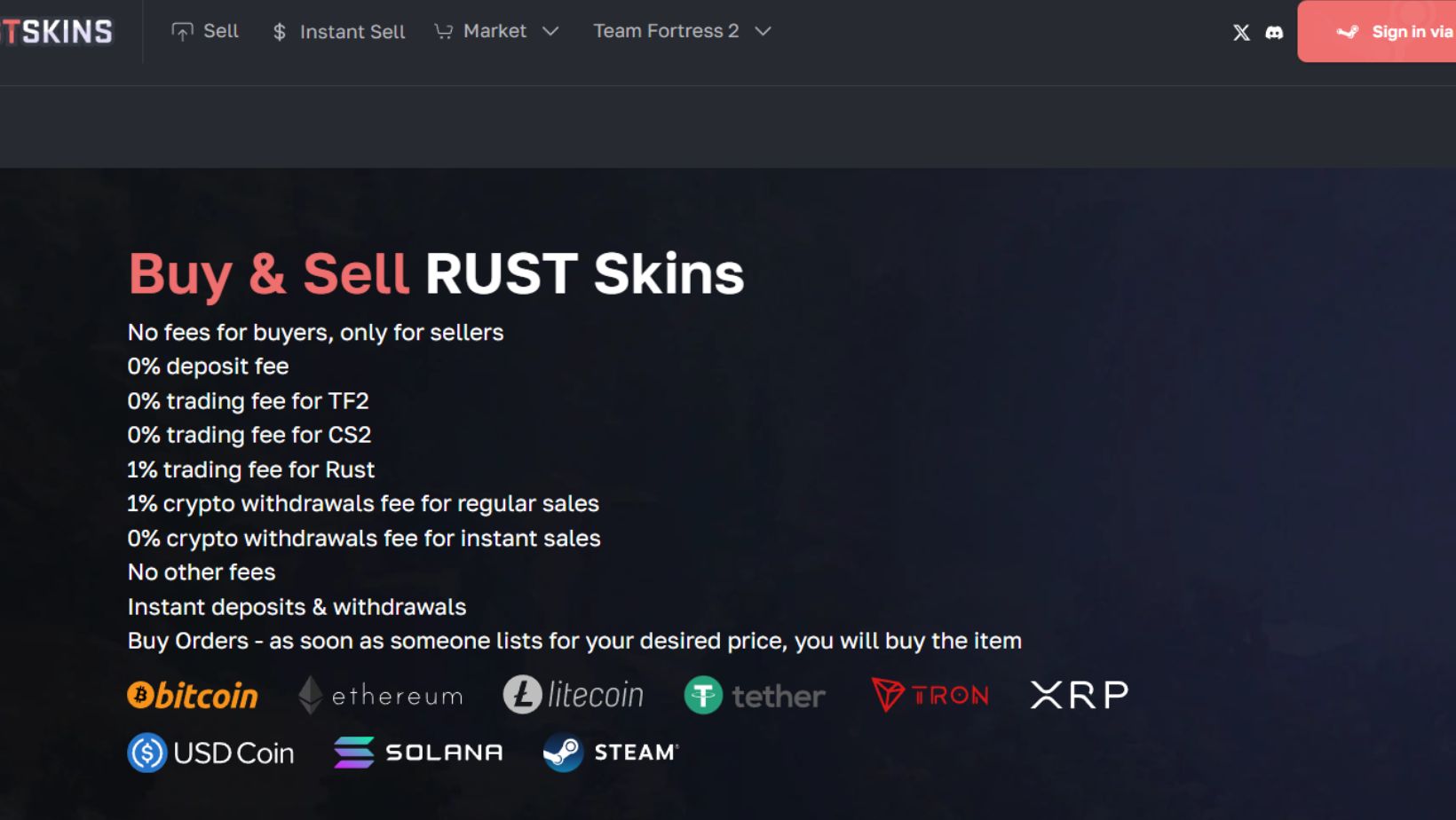
In the 2026 trading landscape, top-tier Rust players have largely abandoned the official Steam market to bypass its restrictive 15% fee and lack of real-world liquidity. This shift represents a broader paradigm change where skins are no longer mere cosmetics but sophisticated digital assets managed through specialized third-party tools.
Because modern platforms now offer distinct advantages, ranging from deep discounts on rare “hero” items to instant bot-driven bulk swaps, choosing the best market requires matching your specific tactical goal to a platform’s unique strength, whether that is finding the absolute lowest price or securing an immediate cash-out to a bank account.
The Three Pillars of Selection: Liquidity, Fees, and Security
Selecting a marketplace in 2026 isn’t just about finding the best-looking UI; it’s a technical decision based on how efficiently a platform moves assets and protects your capital. To maximize your “net value realization,” you must evaluate every site against three non-negotiable pillars: liquidity, fee structures, and the maturity of their security protocols.
Liquidity: The Volume Advantage
In the RUST skins market, high liquidity is the single greatest hedge against price volatility. A platform with a massive user base and high daily transaction volume, such as Skinport or DMarket, ensures “narrow spreads,” meaning the gap between what a buyer pays and what a seller receives is kept to a minimum. For a survivor, this high volume is what makes finding specific “hero” items like a Big Grin or a rare Alien Relic possible in minutes rather than days. Without deep liquidity, you run the risk of the “liquidity trap,” where your funds are tied up in a skin that no one is currently buying, forcing you to slash prices just to get your capital back.
Fee Structures: Minimizing the “Tax”
The “best” site is often determined by who takes the smallest cut of your transaction. In 2026, fee structures have become highly competitive:
- Buyer Fees: Sites like Skinport have become the gold standard for shoppers by offering 0% buyer fees. You pay exactly the price listed on the screen, which is often already 20–30% lower than the Steam Community Market.
- Seller Fees: If you are the one listing items, you need to compare the standard 10% marketplace cuts against “aggressive” fee models. Platforms like CSFloat and DMarket lead the industry with fees as low as 2% to 5% for liquid items. For those looking for an extra boost, https://rainbetreferralcode.com/ offers a separate bonus that can give you added value on your first deposit. Meanwhile, SkinsMonkey uses a unique 35% deposit bonus to effectively neutralize their trading spread, giving you more purchasing power when swapping old gear for a new loadout.
Security Protocols: The 2026 Baseline
Security is the absolute baseline for any third-party interaction. In 2026, a legitimate marketplace must utilize Steam OpenID for logins, ensuring they never see your actual password. Furthermore, the mandatory use of Steam Guard 2FA acts as your final line of defense. The most critical security feature to look for is the “Handshake” Security Code system. When you initiate a trade, a reputable site will generate a unique 8-digit code on their dashboard. You must verify that this exact code appears in the trade message on your Steam Mobile Authenticator before accepting. If the codes don’t match, the trade is a “phantom” offer from a scammer bot, and you should abort the transaction immediately.
Market Categorization: Matching the Site to Your Mission
In 2026, the Rust skin economy has matured into a landscape of specialized platforms. To maximize your efficiency, you must match your specific goal, whether it’s raw savings, lightning-fast liquidation, or tactical browsing, to the marketplace best equipped to handle it.
The “Hustler’s” Choice: Global Marketplaces
If your mission is to find the absolute lowest price on high-value “hero” items like the Big Grin or Alien Red, multi-game marketplaces are your primary tool. These platforms benefit from massive liquidity, meaning there are more sellers competing to offer the lowest price.
- Skinport: As a German-based, EU-regulated marketplace, Skinport is the gold standard for safety. It offers a 0% buyer fee, meaning the price you see is exactly what you pay. It is the premier choice for players looking to “cash out” their inventory or buy high-tier items with total peace of mind.
- DMarket: Utilizing advanced AI-driven pricing and high-volume multi-game liquidity, DMarket is ideal for those who want to trade across different titles. It frequently hosts the deepest inventory of rare Rust assets, making it a “must-check” for collectors hunting for specific patterns or low-float skins.
The “Speedrunner’s” Choice: Bot Trading Sites
When you need to dump a mountain of low-value “junk” skins and upgrade to a high-tier tactical AK-47 in under 30 seconds, bot trading sites are the answer. These platforms prioritize instant execution over the long-tail haggling of a marketplace.
- SkinsMonkey: This platform has solidified its lead in 2026 by offering best-in-class 35% deposit bonuses. For a player looking to “trade up,” this bonus effectively neutralizes the site’s trading commission, allowing for near-instant inventory overhauls. Their automated bots handle the entire “handshake” process, ensuring you are back in the game with your new kit before the next raid cycle begins.
The “Specialist’s” Choice: Rust-Native Sites
For the tactically-minded survivor, general-purpose sites can feel cluttered. Rust-native platforms cater specifically to the game’s unique mechanics, offering filters that multi-game giants often overlook.
- RustSkins: This is the only major platform in 2026 that organizes its inventory by actual gameplay utility. Instead of just “Deployables,” you can filter specifically for the Naval Meta (modular boat parts, sails, and cannons) or Building Tiers (Adobe, Brick, and Brutalist). This makes it the essential tool for players who are building a biome-specific loadout and need to find color-coordinated assets without scrolling through thousands of unrelated CS2 or Dota 2 items.
Verifying Authenticity: The 2026 Red Flag Checklist
As the Rust skin market has become a multi-billion dollar asset class in 2026, scammers have transitioned to highly automated, AI-driven phishing tactics. To protect your inventory, you must look past a site’s sleek UI and verify its mechanical authenticity. Use this three-step verification protocol before connecting your Steam account to any platform.
The Trustpilot Threshold
In 2026, a platform’s reputation is its most valuable currency. You should never engage with a marketplace that holds a Trustpilot rating below 4.4/5. For perspective, industry leaders like SkinsMonkey currently maintain a dominant 4.9/5 rating from over 18,000 verified reviews, while Skinport sits comfortably at 4.6/5. Be wary of “new” sites that claim to have 5-star ratings but only a handful of reviews; legitimate platforms must demonstrate consistent, high-volume performance over several years to be considered a safe harbor for your assets.
The “API Test” and Login Protocol
A legitimate marketplace in 2026 will never ask for your Steam password or your 2FA code directly on their own page. They use Steam OpenID, which redirects you to the official steampowered.com domain to sign in.
- The Red Flag: If you are already logged into Steam in your browser but a site still asks you to type in your username and password, you are likely on a phishing clone.
- The API Trap: Furthermore, be extremely cautious if a site requires you to generate and provide a Steam Web API Key as part of the “registration” process. Scammers use these keys to monitor your account and intercept your trades in real-time. If you suspect your account is compromised, visit the official Steam API page and revoke any keys you didn’t personally authorize.
Bot Maturity and the “Handshake” Check
The automated trading bots used by top-tier sites are professional-grade accounts, not disposable “ghost” profiles. In 2026, a verified trading bot should be a high-level Steam account (Level 10-20+) with several years of service history. If a Level 0 account with a private profile sends you a trade offer, it is a 100% certainty that the offer is a scam.
Always use the “Handshake” Security Code. Legitimate platforms like SkinsMonkey now generate a unique 8-digit code on their dashboard the moment a trade is initiated. You must verify that this exact code matches the one included in the Steam trade message on your mobile phone. If the codes do not match, the trade is a “phantom” offer, decline it immediately and deauthorize all devices.
Cash-Out and Deposit Options
In the 2026 market, the “value” of a skin is no longer just its in-game appearance; it is its liquidity. Understanding the logistics of moving capital in and out of these platforms is what separates a casual player from a strategic trader. By mastering deposit bonuses and withdrawal times, you can effectively increase your purchasing power by over 30% without spending an extra dime.
Funding Your Loadout
For players looking to buy into the 2026 Rust economy, the “Bonus Meta” is the most critical factor. Top-tier platforms like SkinsMonkey and Tradeit.gg have standardized a 30% to 35% deposit bonus for real-money top-ups. This means that depositing $100 via instant bank transfer or card often results in a $135 site balance. When combined with the fact that third-party prices are already 20%–30% lower than Steam, your total purchasing power can nearly double. In 2026, instant funding methods have also evolved, with many EU and North American platforms supporting direct “Open Banking” transfers, allowing you to move from your bank account to a fully skinned loadout in under two minutes.
Withdrawing Profits: Speed vs. Regulation
Cashing out your Rust profits requires a strategic choice between speed and traditional banking reliability. In 2026, withdrawal times are categorized into three main tiers:
- Instant (10–30 Minutes): Cryptocurrency remains the fastest exit strategy. Payouts in Bitcoin (BTC), Ethereum (ETH), or USDT are typically processed as soon as the trade bot confirms receipt of your items.
- Rapid (Up to 48 Hours): Digital wallets like Skrill, Payoneer, and Neteller offer a middle ground, providing relatively quick access to funds that can then be used for other online purchases or moved to a debit card.
- Standard (1–5 Business Days): Traditional SEPA and Wire transfers are the most secure but the slowest. These are best for large “hero item” sales where you want the security of a direct bank deposit and are willing to wait for the standard clearing cycles.
The “Cross-Game” Advantage
One of the most powerful features of 2026 marketplaces is cross-game inventory consolidation. If you have an aging collection of CS2 cases or a high-value Dota 2 courier you no longer use, platforms like DMarket and SkinsMonkey allow you to “bridge” that value directly into Rust. You can deposit items from multiple games into a single unified balance, effectively using your history in other titles to fund a top-tier Rust loadout. This turns your entire Steam library into a single, fluid wallet, ensuring that the value you’ve built up over years of gaming is never “stuck” in a title you no longer play.
Regional Considerations: Where in the World are You?
In 2026, the global nature of the Rust skin market means that your physical location can significantly impact your trading experience.

From varying legal protections to localized payment gateways, where you trade is often as important as what you trade.
European Market Focus
For European players, German-based platforms like Skinport and SkinBaron have become the industry’s “safe harbors.” This is due to Germany’s stringent e-commerce regulations, which in 2026 include the mandatory “Withdrawal Button” (Widerrufsrecht) and advanced transparency requirements for digital financial services. These sites operate under strict EU consumer protection laws, meaning you have a clear legal framework for dispute resolution and data privacy that offshore platforms simply cannot match. If you are a high-volume trader in the EU, prioritizing these regulated markets is the best way to safeguard your capital against platform insolvency or technical errors.
The Asian Liquidity Giant
Despite its complex, primarily Chinese interface, Buff163 remains the undisputed king of inventory volume in 2026. Because it services the massive Asian player base, it often hosts listings for rare “hero” items and tactical sets that are completely sold out on Western sites. For the serious global trader, Buff163 offers the most competitive pricing due to its sheer number of active sellers. However, navigating it requires a degree of technical patience, as you’ll often need to manage third-party “balance” top-ups and use browser translation tools to navigate the menus. For those who can master it, the reward is access to the world’s deepest pool of Rust assets.
Global Access
The “best” market is also the one that supports your local financial infrastructure. In 2026, the payment landscape is divided by utility:
- PayPal & E-Wallets: Still the most accessible method for international players in over 200 countries, though often carrying higher fees (around 3–4%). It remains the go-to for casual buyers who prioritize ease of use.
- Open Banking & Local Transfers: In Europe and the UK, SEPA and Faster Payments have become the standard for 0-fee deposits. Sites like Skinport excel here, allowing you to fund a loadout directly from your bank in seconds.
- The Crypto Gateway: For players in regions with restrictive banking, or those seeking near-instant cross-border liquidity, USDT and Bitcoin are the dominant choices. Platforms like DMarket and Tradeit.gg provide 24/7 crypto processing, ensuring that you can liquidate a kit and have funds in your wallet regardless of your local bank’s operating hours.
Conclusion
Navigating the Rust skin economy in 2026 is no longer about finding a single “all-in-one” website. The most successful survivors treat their inventory like a professional toolkit, utilizing different platforms for specific tactical advantages. By diversifying where you trade, you maximize your margins, ensure the highest level of security, and maintain constant liquidity across the entire wipe cycle.