
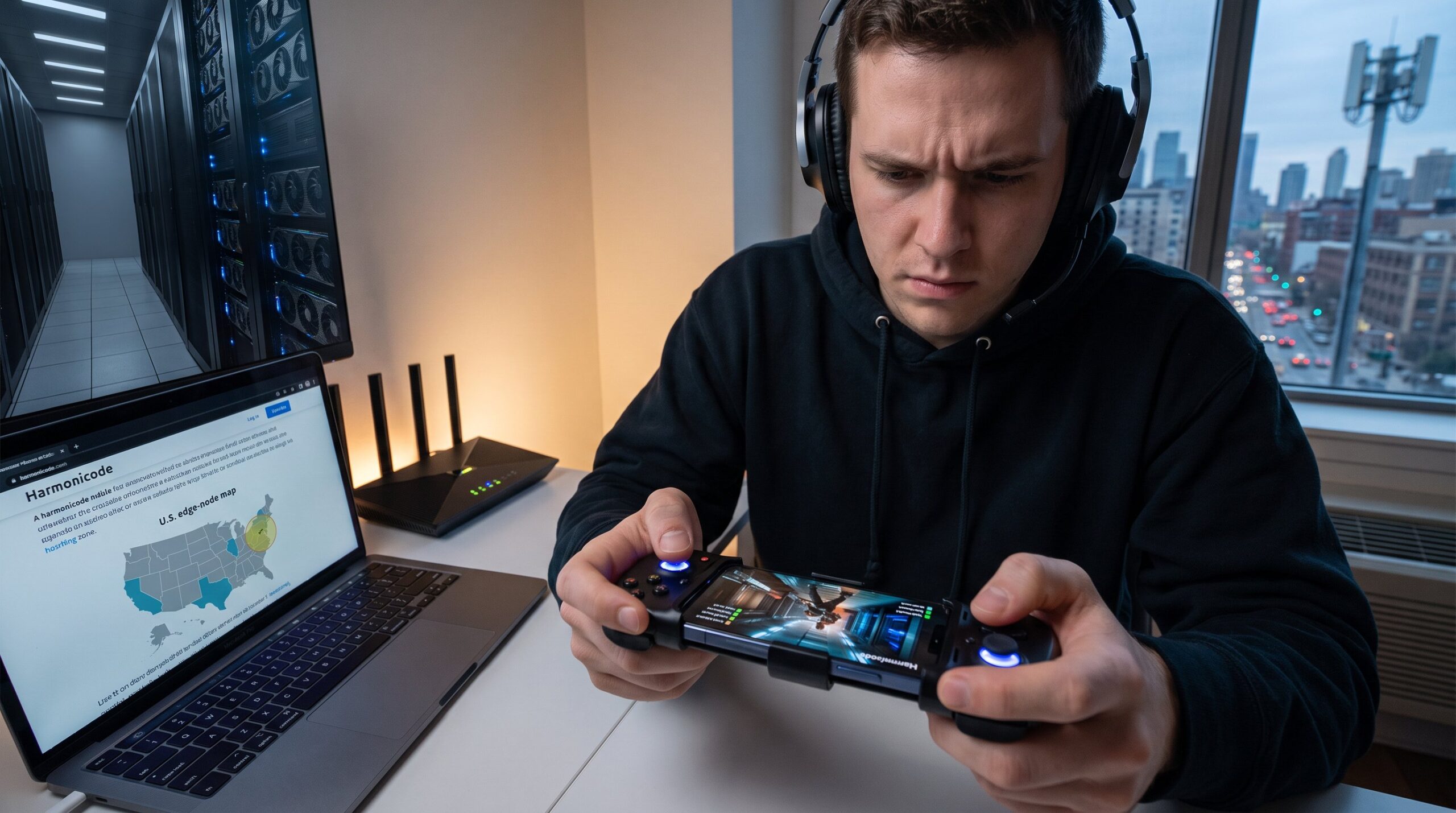
Harmonicode Coverage of Cloud and Mobile Gaming is timely: cloud streaming and powerful phones are reshaping play. In 2026, gamers expect console-quality titles on phones and low-power PCs. This guide explains why both trends matter today, how streaming and mobile delivery actually run, what players and streamers gain, and which fixes make cloud play feel tight. It targets competitive players, streamers, and hobbyists who want practical steps to improve responsiveness and visual fidelity without buying a new GPU. Those looking for more depth can read the site guide.
Key Takeaways
- Harmonicode’s coverage highlights how cloud and mobile gaming deliver console-quality experiences on ordinary devices, unlocking high-end play without expensive hardware upgrades.
- The core technology involves remote GPUs rendering frames, hardware encoders compressing video, and edge computing to reduce latency and improve responsiveness in cloud gaming.
- Cloud and mobile gaming expand access for gamers, enable scalable streaming for content creators, and lower costs for esports organizers by standardizing hardware environments.
- Network quality is the biggest challenge for cloud play; practical fixes include choosing nearby servers, using wired connections or strong 5G signals, and prioritizing framerate over resolution for better input responsiveness.
- Adaptive streaming and perceptual-rate control algorithms can significantly reduce bandwidth and latency, enhancing visual fidelity and smooth gameplay in cloud gaming.
- Harmonicode provides actionable guides and platform tests that help competitive players, streamers, and hobbyists optimize their cloud and mobile gaming experience effectively.
Why Cloud And Mobile Gaming Matter Now
Cloud and mobile gaming matter now because they unlock high-end experiences on ordinary devices. In 2026 the largest entry point for new players remains mobile, while cloud services let a smartphone match a desktop GPU for graphics and physics. Investors and platform owners poured billions into remote GPU farms and edge nodes: that investment turned fragile demos into usable services. For players in regions with weak PC shops, cloud reduces upfront cost, someone can play a modern AAA title on a five-year-old laptop. For streamers, cloud routing scales audience reach without local capture hardware. Harmonicode’s coverage hub sits at the crossroad of these trends, collecting hands-on guides and platform tests for players who need clear, actionable info.
How Cloud And Mobile Gaming Work
The core fact: servers render frames, encode video, stream pixels, and process inputs in a tight loop. A remote GPU renders a frame, a hardware encoder compresses it, the server sends the compressed video to the client, and the client sends input packets back. This loop must complete fast enough that the player perceives direct control. Key enablers are adaptive streaming, input transport protocols, and edge placement near players. Mobile networks now use 5G slices and edge compute to shave milliseconds. For a concrete example, a deployed platform reduced bandwidth by 44.27% and end-to-end latency by 8.37% using perceptual-rate control algorithms.
Key Technical Components Behind Cloud Play
Remote GPUs, low-latency encoders, and adaptive bitrate control are non-negotiable for smooth cloud play. Remote GPUs run game logic and generate high-resolution frames. Hardware encoders (AV1, H.265) compress frames with low delay. Adaptive streaming adjusts bitrate to packet loss and motion intensity, preserving visual clarity where it matters. Input transport uses UDP or QUIC to prioritize small input packets over bulk video. Edge computing places servers nearer to players: doing so cuts physical distance and so latency. Network optimization techniques like forward error correction and jitter buffers reduce packet loss impact. Together, these components form the streaming loop that turns a phone into a modern gaming client. For a practical hardware look at handheld clients, see the Logitech G Cloud review that explains how devices pair with cloud backends.
Benefits For Gamers, Streamers, And Esports
Fact first: cloud plus mobile widens access and scales viewership. Gamers gain access to games otherwise blocked by hardware budgets, a $300 phone can run ray-traced scenes streamed from a remote GPU. Streamers can invite remote co-players without shipping capture rigs, reducing setup time by hours each week. Esports organizers can stage remote qualifiers on standardized server builds, minimizing hardware advantage and lowering staging costs. For example, small tournament hosts reported cutting per-player setup from 90 minutes to under 15 by standardizing on cloud clients. Mobile players enjoy portability and instant updates: no downloads, immediate patches. These benefits expand player pools in emerging regions and diversify viewership for esports broadcasts. Harmonicode‘s content links players to beginner resources and trend pieces so readers can apply these gains immediately across platforms.
Challenges, Tradeoffs, And Practical Fixes
Core challenge: network quality governs play. Latency, jitter, and packet loss produce input lag, stutter, and visual artifacts. Another tradeoff is bandwidth: higher quality needs more bits, creating a cost-for-quality decision for providers and users. Reliability matters too: power or carrier drops interrupt competitive matches. Practical fixes exist: pick the nearest server region, prefer wired Ethernet when possible, and prioritize low-latency network paths. For mobile, using 5G with a strong signal and edge-enabled services cuts round-trip time. Players should test multiple providers and set the client to favor framerate over resolution for faster feedback. Harmonicode‘s technical guides explain step-by-step tweaks and offer platform comparisons for readers who want hands-on tests and setup walkthroughs.
Latency, Bandwidth, And Reliability Solutions
Solution first: reduce distance, stabilize the link, and tune streams. Choose the closest availability zone or edge node to shave physical distance. Use Ethernet for consistent throughput: if on Wi‑Fi, upgrade to Wi‑Fi 6/6E/7 and place the client close to the router. Enable QoS rules on home routers to prioritize gaming packets over bulk sync. Adaptive bitrate and perceptual-quality-aware rate control can cut bandwidth by ~44% while trimming latency about 8% on real platforms: those numbers come from deployed research on modern cloud stacks. For mobile users, prefer strong 5G cells and avoid carrier handoff areas. Finally, use clients that support packet recovery and automated nearest-server selection to reduce jitter. For practical platform recommendations and regional tests, consult Harmonicode’s platform reviews and setup guides.
Conclusion
Cloud and mobile gaming combine flexibility with high-end server delivery, but the experience still hinges on networks. Players can get the best results by choosing nearby servers, stabilizing local networks, and favoring responsiveness over raw resolution. Harmonicode’s ongoing coverage helps players pick providers and adjust settings for competition, streaming, and casual play, practical steps that matter more than marketing claims.

