
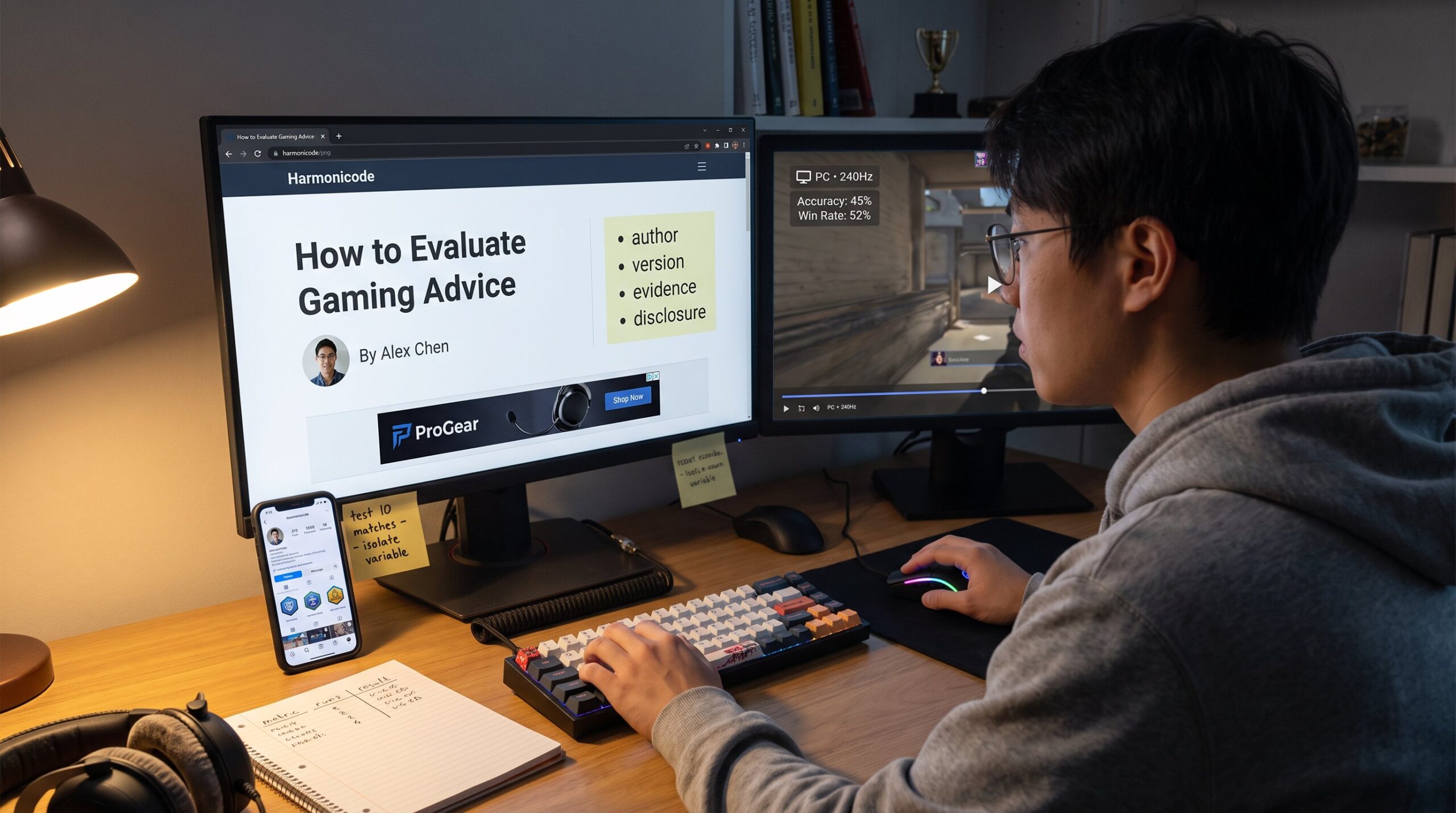
How to evaluate gaming advice on Harmonicode starts with three questions: who wrote it, why they wrote it, and does it work in play? Harmonicode readers rely on guides that change practice, training time, and buying choices. A clear, short checklist saves time and prevents following outdated or monetized tips that hurt rank or wallet. The guide that follows gives precise checks, quick tests, and real warnings so readers can sort reliable recommendations from weak ones in minutes.
Key Takeaways
- Evaluate gaming advice on Harmonicode by verifying the author’s credibility, experience, and disclosed monetization to ensure reliability.
- Check that tips specify game version, platform, and rank context since outdated advice can harm your gameplay or purchases.
- Prefer gaming tips supported by measurable evidence like session data or annotated clips rather than subjective statements.
- Test one tip at a time in-game using controlled variables and track measurable outcomes to validate effectiveness.
- Cross-check advice with independent sources and avoid following suggestions lacking quantifiable testing or transparency.
- Maintain records of test results including game version and platform to adapt swiftly to meta changes and patches.
Why Evaluating Gaming Advice Matters For Harmonicode Readers
Fact up front: Bad or outdated advice costs players time and often money. Harmonicode publishes strategy and gear guidance that can change a player’s training routine or purchases: when readers apply incorrect tips they lose matches, waste hours, or buy the wrong accessory.
Why this matters now: patches and meta shifts hit competitive games weekly. One change to aim assist or weapon recoil can make a formerly solid sensitivity or drill harmful. Harmonicode’s coverage spans Rocket League, retro, and modern titles, so context matters, advice that helped a pro in Season 2 may be useless after a balance update in Season 5. Those wanting more background can turn to the resource guide for the fuller picture.
Concrete example: a sensitivity recommendation tested on a 60Hz console match won’t translate to a 240Hz PC setup. That mismatch can cost a player 5–10% of tracking accuracy in close firefights.
Practical takeaway: readers should treat every tactic as versioned content. Before adopting a suggestion from a Harmonicode article, check whether the piece names the game version, platform, and rank context. If it doesn’t, the tip is incomplete.
Related help on the site: For where to read match reports and event context, consult the short guide that maps coverage to titles in esports sections. That makes it easier to know whether an article reflects pro play, casual tips, or vendor-driven advice.
Verify Author Credibility, Experience, And Monetization Signals
Key fact: the author’s background predicts how reliable the advice will be. Harmonicode readers should first confirm the writer’s name, bio, and past work. An author who lists tournament finishes, coaching roles, or 5+ years covering a title carries more weight than an anonymous guest post.
How to check fast: scan the byline, then click the author profile for past posts and stated credentials. If the piece claims pro experience but links only to streamer clips, that’s a red flag.
Monetization red flags to watch: affiliate links to headsets or mice that appear in a shopping list, sponsored tags at the top, or persistent promo codes. These don’t automatically invalidate the advice, but they create a conflict of interest. For example, a promoted mouse sensitivity article that sells the author’s affiliate link should include independent testing numbers and clear disclosure.
A relevant real-world account: a consultant who advised studios told Kotaku that many freelance writers mix opinion and paid work: transparency matters when they recommend paid services or hardware. This is supported by interviews with industry consultants in publications like Kotaku’s profile of consultants.
Quick checklist readers can use:
- Is there a named author with a verifiable profile?
- Does the bio list relevant experience (coaching, tournament play, long-term coverage)?
- Are product links labeled or disclosed?
- Do recommendations include independent measurements or only subjective praise?
If answers are weak, treat tips as hypotheses and test them before investing hours or cash. For background on the site’s editorial approach, readers can compare guidance to the broader site mission in the Harmonicode.com Gaming Blog.
Evaluate Claims, Evidence, And Practical Reproducibility
Direct insight: good gaming advice links a clear claim to measurable evidence. Prefer statements like “this warm‑up raises average score by 5 points over 10 matches” rather than “this warm‑up feels better.”
What counts as evidence on Harmonicode: quantified session data, replay comparisons, timestamps, or annotated clips. When an article includes screenshots of settings, raw stat tables, or short clips with timestamps, readers gain the ability to reproduce steps exactly.
Context checks readers should perform:
- Platform and version: does the tip name PC/console/mobile and the game patch?
- Skill bracket: was the test run on bronze, diamond, or pro accounts?
- Reproducibility: are the exact settings and sequence listed so another player can try them?
Concrete example: a sensitivity change tied to a measured 7% improvement in target tracking is useful only if it lists mouse DPI, polling rate, and sensor smoothing. Without those numbers, the result is anecdote.
Cross‑checking: compare the claim to at least one independent source on the same topic. For mechanics and training routines, Harmonicode’s practice guides can be compared to the site’s new and casual player guides or to analytics pieces on how games measure performance in play, such as analysis articles.
Practical warning: never accept a blanket gear claim without test data. A headset claim of “improves sound localization” should come with AB testing or at least controlled comparison notes. If an article lacks measurable evidence, mark it for in‑game testing before changing routines or buying gear.
How To Test Tips In-Game: A Simple Step-By-Step Method
Answer first: test one tip at a time with a measurable goal.
Step 1, Define a metric: pick something measurable like +5 points per match, win rate change, accuracy %, or a replay error count.
Step 2, Isolate the variable: change only one thing (sensitivity, warm‑up drill, HUD layout) so results are attributable.
Step 3, Run a controlled sample: play a fixed number of matches or training runs (for example, 10 ranked matches or 20 practice drills) with the new setting.
Step 4, Log results: use in‑game stats, third‑party trackers, or simple spreadsheets. Save 2–3 replays to verify the numbers.
Step 5, Compare and decide: if the metric improves consistently across sessions, keep the tip: if results are mixed, revert and try a different variable.
Example: a player who wants a +3% headshot rate changes aim smoothing alone, runs 15 matches, logs a 4% increase, and reviews 3 replays showing cleaner tracking. That tip is validated. If the player’s win rate drops even though accuracy gains, they must weigh goals, accuracy versus decision‑making.
Record keeping tip: tag each test with the game version and platform in the notes. That saves time when a future patch shifts the meta.
For practical, video-driven walkthroughs on applying tips, readers can follow the instructional flow used by the site’s HMCDGamers guide.
Conclusion
Final insight: Harmonicode readers avoid wasted time by checking author credibility, monetization, evidence, and then running single‑variable in‑game tests. This process turns hearsay into verifiable improvement. When in doubt, prioritize tips with clear numbers, saved replays, and transparent funding. For a broader orientation on the site’s scope and coverage, consult the pillar overview of site coverage.

